Industrial Modernism & Engineered Form
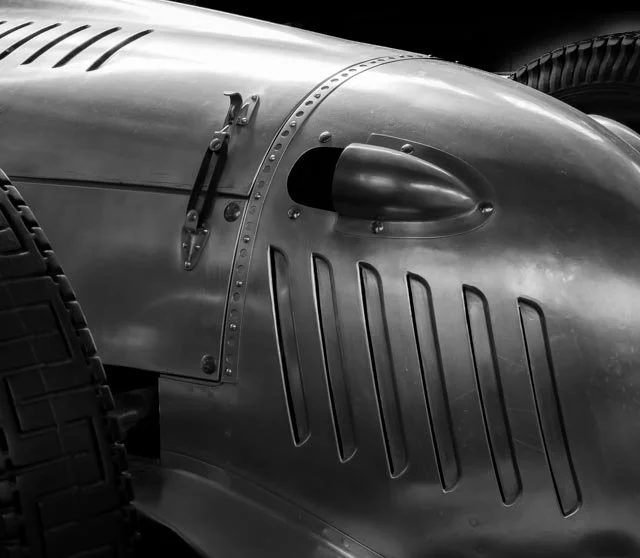
The objects I photograph were built to do a job: to carry loads, transfer force, hold pressure, and move. Their makers saw performance and form as one and the same. That idea is at the heart of this work.
The project is divided into three parts. Iron & Speed looks at machinery like engines, propulsion systems, and mechanical assemblies, showing how their look comes from the jobs they do. I invite viewers to notice the functional details—bolted joints, shaped housings, and exposed mechanisms—that reveal how each element works together. Designed Objects focuses on vehicles and tools such as cars, planes, boats, and the tools that built them, encouraging you to look for how design ideas and manufacturing culture are expressed in their shapes, surfaces, and visible wear. Engineered Space examines industrial and modernist buildings such as dry docks, fabrication halls, gantries, and frames, treating them as abstract compositions. As you move through these images, look for the repeating patterns, structural rhythms, and moments where careful design in large structures mirrors the precision in the smallest parts.
This is not a romantic view of industry from the outside. Ships, aircraft, and machines are not made to be photographed; they are made to work. Every part of their shape is there because an engineer decided it was needed. That need is what gives these objects their power. This work suggests that the strongest design choices of the industrial age often come from engineers, not artists. Photographing these objects with the same care they were built with is the truest way to show them.
This work is personal to me. I grew up in Highland Park, Michigan, where the moving assembly line first changed how the world worked. My family worked for Ford, and after high school, I worked at Ford’s River Rouge plant before joining the United States Marine Corps. I learned firsthand what it means when engineering and purpose come together in one object. I have been taking photographs since the 1970s, and that early lesson has shaped how I see through a camera. It is the base of everything in this project.
The work is made in the tradition of the American Precisionists. Charles Sheeler, known for his precise photographs that capture the stark beauty and structure of American industry, created images of the Rouge that still remain the standard for industrial form. The typological practice of Bernd and Hilla Becher, whose systematic series of water towers and industrial buildings focused on the understated logic and variation in engineered structures, also informs this project. The contemporary industrial photography of Christopher Payne, with its attention to detail and exploration of large-scale production in modern settings, is another influence. Together, these precedents frame the three bodies of work and clarify what this kind of photography is for.
The camera works from ground level, in available light. Discipline as method. Clarity as intent.
Across all three series, the subject is the same: form that earns its right to exist through the logic of its making, and that is the final measure of the work.
Black-and-white archival pigment prints. Medium edition 20 × 24 in.; large edition 30 × 40 in. Each an edition of 10. Available by inquiry.